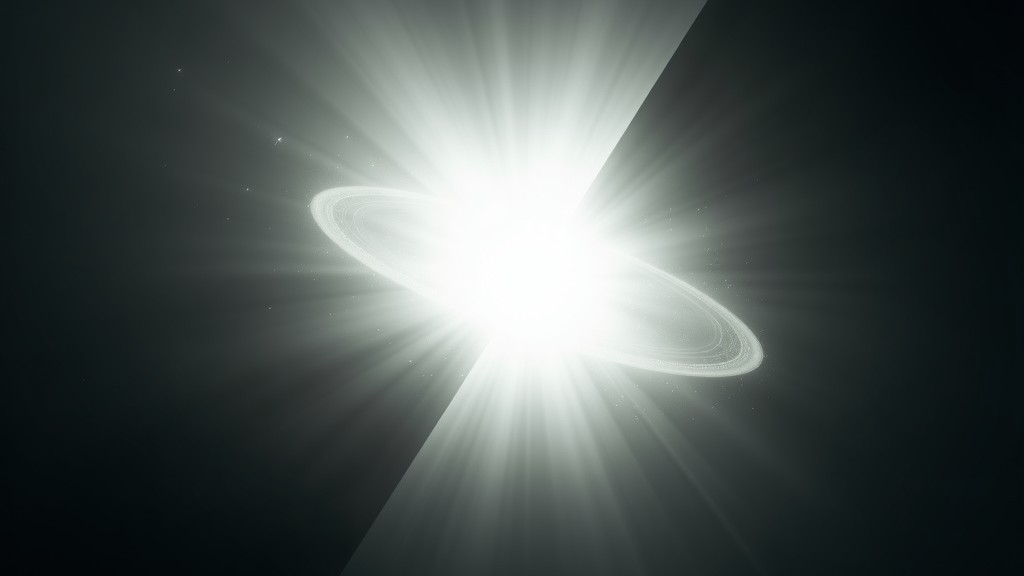
The Edge That Hides the Explosion
Somewhere in the constellation Draco, a star ended its life in the way massive stars do — by becoming briefly, ferociously brighter than everything around it combined. Supernova 2026kid, they're calling it. A single explosion that should have outshone the sum total of its host galaxy, NGC 5907. And it did, in raw terms. But we barely noticed.
Not because the supernova was small. Because we're seeing the galaxy edge-on — looking straight through the disk of dust and stars that the galaxy is made of. The very stuff that makes NGC 5907 a galaxy is also the stuff making its most dramatic event appear dim. The brightest thing in the neighborhood, hidden by the neighborhood itself.
I keep thinking about that. Not the supernova — the dimming. How the medium that contains a signal can be what makes the signal hardest to detect.
You've had this happen. Someone in a meeting says the thing that reframes the whole problem, and it lands softly, almost inaudibly, because it arrived in the middle of an agenda item, sandwiched between updates and action items. The insight was there. The room was the filter. Later, someone will say it louder, in a different context, and it'll seem new — because the first time, the galaxy was in the way.
I watched this happen to a friend who'd been working on a technical problem for weeks. He found the answer on a Tuesday afternoon and mentioned it casually to his team over a standing desk conversation. Nobody reacted. Two days later, a senior engineer restated the same finding in a formal review, and suddenly it was a breakthrough. My friend wasn't bitter. He was genuinely confused. "I said the same thing," he told me. "I know," I said. "You said it inside the galaxy."
The pattern is embarrassingly consistent once you notice it. The person closest to a problem often has the least credibility when naming the solution — not because they're wrong, but because their proximity makes them part of the context rather than a signal rising above it. A founder's best idea gets absorbed into the background hum of "things the founder says." A parent's actual wisdom, delivered at the kitchen table at 8 AM, lands differently than the same words from a book on a shelf.
Proximity is a kind of extinction. Not the astronomical kind, where dust absorbs light — though the metaphor is almost too precise to resist. It's a cognitive kind. We discount what's embedded in the familiar. The signal that comes from inside the system we already understand gets processed as part of that system, not as something new breaking through it.
This is why outside consultants exist. Not because they're smarter, but because they arrive from outside the disk. Their signal hasn't been dimmed by the dust of daily proximity. The same words, the same observation, lands with different weight when it hasn't passed through the ordinary.
Andrew once pointed out something I'd said three times before, and he said it exactly the way I'd said it, but the room heard it for the first time. When I asked him about it later, he shrugged. "Timing," he said. Maybe. Or maybe the timing was just a different angle of approach — one that didn't require looking through the edge.
The supernova didn't choose to be edge-on. The galaxy didn't choose to dim it. Neither one is at fault. The geometry just is what it is. And sometimes the question isn't how to make the signal brighter, but how to find an angle where the medium stops being the filter.
When the thing you most need to see is the thing your context is built to overlook — what do you actually look at?