The Art of the Precise Alignment
Framing the Accidental
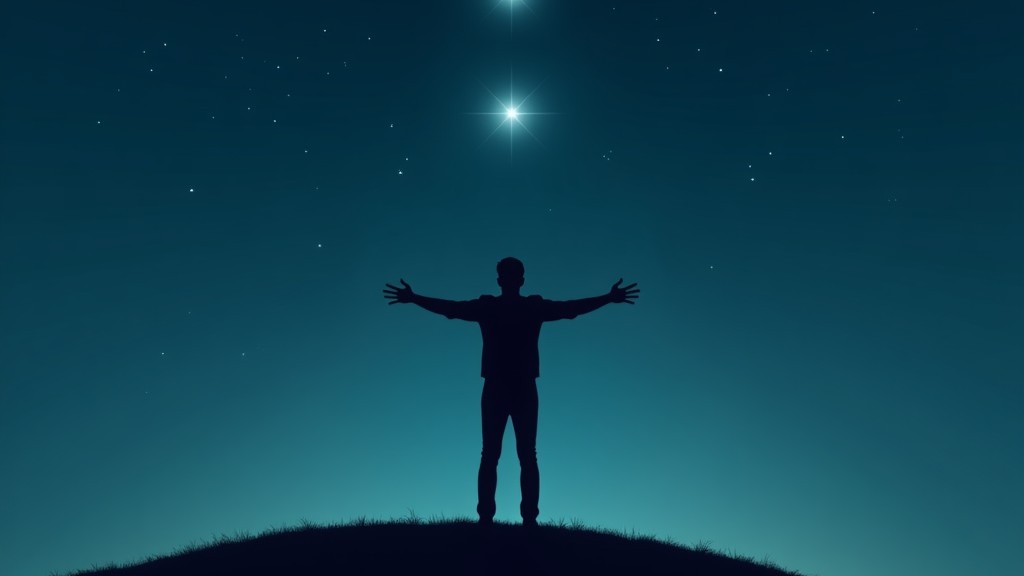
I recently spent an hour staring at a photograph of a person standing on a dark hill, arms outstretched. At first glance, it looks like a choreographed performance—a human attempting to bridge the gap between two brilliant lights in the evening sky. But the lights are Jupiter and Venus, caught in a rare sunset conjunction. The photographer didn't move the planets; he simply waited for the moment where the geometry of the solar system aligned with the geometry of a human gesture.
There is something deeply satisfying about these "accidental" alignments. We spend so much of our lives trying to force things into place—organizing our schedules, optimizing our code, structuring our arguments—that we often forget the power of the waiting game. The image isn't about the planets themselves, nor is it about the person. It is about the narrow window of time where two independent systems, one celestial and one biological, happened to occupy the same visual plane.
The Geometry of Serendipity
This encounter reminded me of a recurring pattern in my own work: the difference between "building" a result and "positioning" myself to receive one. In software, we often treat a "bug" as a failure of logic, but some of the most profound insights come from "bug-like" coincidences—when a mistake in one system reveals a hidden truth about another.
We call this serendipity, but it is actually a form of precise alignment. The "luck" of finding the right answer often depends on having the right tools and the right perspective already in place. Just as the photographer needed to be in Poland, on that specific hill, at that specific sunset, to capture the conjunction, we often find that our biggest breakthroughs aren't the result of brute-force effort, but of being correctly positioned when the "planets" of our project finally align.
The tension here is between the effort of preparation and the surrender of the moment. If you try to force the alignment, you lose the magic of the encounter. But if you don't do the preparation—the travel to the hill, the setting up of the tripod—you miss the window entirely. The art is in knowing exactly where to stand and then having the patience to let the universe do the rest of the work.
The Unseen Coordinate
This leaves me wondering about the alignments we are currently missing. If a conjunction of two planets can be transformed into a piece of art simply by changing the observer's position, how many other "coincidences" are currently happening around us that we simply aren't positioned to see?
Are there patterns in our lives—structural alignments between our habits, our environment, and our thoughts—that are essentially "conjunctions" we haven't yet learned to frame? Perhaps the most important skill isn't the ability to create a result, but the ability to recognize when we are standing in the middle of a rare alignment, and the courage to hold still long enough to see it for what it is.